Sourcing Cw114c Sulfur Copper Material starts with confirming exactly what the designation means for your application. Do not rely on a product title alone. Copper grades and trade descriptions can vary between suppliers, and a small naming mismatch may affect machining, performance, or acceptance. Ask the supplier to identify the applicable standard and provide the material’s documented chemical composition. Details matter.
A reliable inquiry should also specify the product form, dimensions, tolerances, quantity, and intended use. For bar stock, for example, request the diameter, length, surface condition, and required delivery condition. Ask for a mill test certificate or equivalent inspection record, then check that its grade and heat or batch number match the quoted material. If the material will be machined, discuss the operation with the supplier and request a representative sample when practical. A neat datasheet helps, but it cannot replace verification.
Evaluate more than price. Review the supplier’s experience with the requested copper grade, quality controls, traceability, packaging, lead time, and process for handling nonconforming material. Confirm how the goods will be protected from moisture, scratches, and contamination during storage and transport. Keep written records of specifications and approvals. Even experienced buyers can overlook a detail when schedules are tight. That deserves a second look. With clear requirements and evidence that matches the delivered batch, you can reduce sourcing uncertainty and make a more informed purchasing decision.
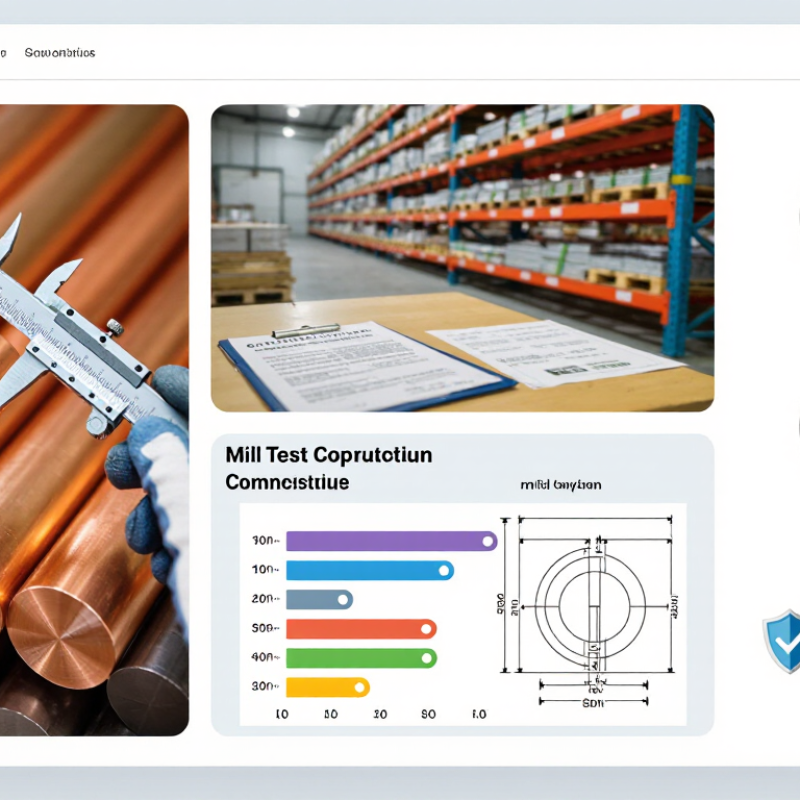
CW114C, commonly identified as CuSP, is a sulfur-bearing copper alloy for free-machining applications. Its key chemistry is 0.20–0.50% sulfur, with copper as the balance. EN 12164, the European standard for copper-alloy rod for free machining, is a useful reference when checking the grade and product form. A label alone is not enough. Ask for a material test certificate showing measured sulfur and copper values, plus the applicable standard and delivery condition.
When comparing supplier offers, check that the certificate identifies CW114C or CuSP—not simply “sulfur copper.” Confirm the bar or rod dimensions, tolerances, and temper against the drawing.
A few tenths of a percent matter: sulfur supports chip breaking, but chemistry should stay within the stated range. Check the certificate.
For incoming inspection, match its heat or batch number to the package tag, then retain both records. This step is easy to miss when bars arrive bundled.
If the supplier quotes another national designation, request its composition table and verify each limit against EN 12164 before approving substitution.
The wording “copper balance” does not remove the need to check any additional limits listed in the standard.
When sourcing CW114C sulfur copper, identify the product form before requesting a price. EN 12164 covers copper and copper-alloy rod for free-machining purposes; do not assume a rod certificate also covers profiles or hollow sections. State round bar, for example, then give the diameter and cut length. Add the required temper and the applicable mechanical-property test. CW114C is commonly designated CuSP, but confirm the grade and chemistry against the supplier’s batch test certificate. Small details matter.
Write tolerances as numbers, not “close tolerance.” Specify permitted diameter variation, length variation, straightness, and surface condition. ISO 286-1 defines IT tolerance grades from IT01 to IT18, but a grade alone may not describe every bar requirement; state the actual limits and measurement method. Ask whether dimensions apply before or after cutting. That point is easy to miss. A practical purchase specification also names the governing product standard, inspection documents, and whether test results are required for each batch. Reflect on your machining setup, too: a tolerance suitable for raw stock may be unnecessarily tight after finishing. Verify it with the machinist before ordering.
| Specification field | Example purchase requirement | Details to confirm when ordering |
|---|---|---|
| Material designation | CW114C sulfur copper (CuSP) | State the required designation and applicable material standard on the enquiry and purchase order. Request a material test certificate confirming the supplied grade. |
| Product form | Round bar | Other possible forms include flat bar or rod, subject to the producer’s CW114C product range. Specify whether the material is supplied straight, cut to length, or in coils. |
| Round-bar dimensions | Diameter: 20 mm; length: 3,000 mm | Give the diameter and required length in millimetres. Identify whether the length is fixed, random, or cut to length. |
| Alternative flat-bar dimensions | Width: 25 mm; thickness: 6 mm; length: 2,000 mm | List width, thickness, and length separately. Confirm whether the dimensions are nominal or finished dimensions. |
| Temper / condition | As supplied; require the producer to state the delivered condition | If mechanical properties or machinability depend on condition, specify the required properties or an agreed temper designation. Confirm that the requested condition is available for the selected form and size. |
| Suggested dimensional tolerances for enquiry | Round bar diameter: ±0.10 mm; cut length: +5 / 0 mm | These are example purchaser-requested targets, not guaranteed CW114C standard tolerances. Agree the applicable tolerance standard and achievable limits with the producer before ordering. |
| Surface and straightness | Specify surface condition and maximum permitted straightness deviation on the drawing or order | State any restrictions on scratches, scale, oxidation, or other surface defects, and define the inspection method where these are critical. |
| Quantity and certification | Specify quantity by pieces or total mass; request a material test certificate | Include packaging, marking, traceability, and inspection-document requirements in the purchase order. |
Note: Dimensions and tolerance values shown are example sourcing requirements. Confirm grade, product availability, temper, and agreed tolerances with the material producer before purchase.
Treat 100% IACS as a reference, not an automatic pass-or-fail value. At 20°C, this benchmark corresponds to about 58 MS/m, or 1.724 μΩ·cm. CW114C contains sulfur to improve machinability, so its conductivity may be lower than that of high-conductivity copper. Check the grade specification and product condition before setting a limit. Small details matter.
When requesting quotes, state a minimum conductivity in % IACS alongside the CW114C designation. Ask suppliers for a material test certificate showing measured conductivity, test temperature, and test method. Compare like with like: bar, rod, and profile can differ in processing history and condition. Do not infer performance from color, chip shape, or a generic copper label. That is weak evidence.
If your component carries current while being machined, balance electrical losses against cutting behavior and dimensional stability. Request a sample from the intended production lot, then test it with a calibrated instrument or independent laboratory. Record the acceptance range before ordering, including whether it applies to every piece or a sampling plan. I would revisit any target copied directly from pure copper. Too easy to assume.
When sourcing CW114C sulfur copper, request the EN 10204 3.1 certificate before shipment. Check that it identifies the exact grade, applicable product standard, delivery condition, and heat number. The certificate should show measured chemical results for that heat, not only a statement that the material meets requirements. Compare each reported value with the limits in your purchase specification. Small details matter.
Match the heat number on the certificate to the tags on the bars, billets, or bundles you receive. Confirm that the listed chemistry covers the elements relevant to your specification, including any sulfur limits or additions. Do not assume a generic certificate applies to every batch. A 3.1 inspection document is validated by the manufacturer’s authorized inspection representative, independent of the production department. Ask for a corrected document if the heat number, grade, or test results are missing or unclear. Keep a copy with receiving records; traceability is harder to rebuild later. One caution: grade names can be used loosely in sales descriptions, so confirm CW114C against the technical specification before placing the order.
Request an EN 10204 3.1 certificate with chemistry results specific to the supplied heat.
The chart shows the CW114C (CuSP) sulfur range of 0.40–0.70 wt%, not results for a particular heat. Ask the supplier to show the actual heat-specific chemistry on the 3.1 certificate, and confirm limits against the applicable product standard and purchase specification.
When sourcing CW114C sulfur copper material, compare suppliers using the same specification: product form, dimensions, temper, tolerances, and required quantity. Request a mill test certificate linked to each heat or batch, showing chemical composition and inspection results. Then check whether the supplier can connect that batch to its mill and processing records. Ask for evidence. A generic certificate without a matching batch number is a weak traceability trail.
Compare minimum order quantity against your actual cutting plan, not just the quoted price per kilogram. A low MOQ may suit prototypes, while larger production orders may need reserved stock. The International Copper Study Group’s World Copper Factbook 2024 reports about 26.5 million tonnes of global refined copper production in 2023; that broad figure does not confirm CW114C availability. Check stock by exact grade and size. Small lots matter. For lead time, separate material preparation from transport, and ask for written estimates for both. UNCTAD’s Review of Maritime Transport 2024 documented major disruption at key shipping routes, so a dispatch date alone is not a reliable arrival promise. Request an estimated ship date, transit range, and a delay update point. I would still verify these details against a sample order; supplier calendars can be optimistic.
It is a sulfur-bearing copper alloy used for free-machining applications. Copper makes up the balance.
The stated range is 0.20–0.50%. Compare the measured value with your purchase specification.
No. Ask for a certificate identifying CW114C or CuSP and the applicable product standard. A tidy label is tempting to trust, but it is not proof.
Check for the exact grade, product standard, delivery condition, heat number, and measured chemical results. Small details matter.
Match its heat number to the tags on the bars, billets, or bundle. Check the tag.
Do not assume it covers every batch. Request heat-specific chemistry results for the material being supplied.
Confirm dimensions, tolerances, and temper against the drawing. The grade alone does not specify these details.
Request its composition table and compare each limit with the applicable specification before approving substitution. A quick name match may miss a limit.
Sourcing Cw114c Sulfur Copper Material starts with confirming the material identity and composition: CW114C, also known as CuSP, contains 0.20–0.50% sulfur, with copper making up the balance. Before requesting quotations, define the required product form, dimensions, temper, and tolerances so suppliers can assess whether their available stock and production capabilities match the application. Specify any conductivity requirement clearly, using 100% IACS copper as the comparison benchmark.
For quality verification, request an EN 10204 3.1 inspection certificate that includes chemistry results linked to the relevant heat. Compare potential suppliers not only on price, but also on material traceability, minimum order quantity, and lead time. Reviewing these details together can help ensure that the selected material meets the required composition and delivery expectations, while reducing the risk of receiving stock that does not fit the intended specifications.
Kepai New Material