Buying Oxygen Free High Conductivity Tellurium Copper requires more than comparing prices on a supplier website. This alloy is valued for high electrical conductivity, low oxygen content, and improved machinability from tellurium additions. Those properties matter in electrical terminals, precision components, switchgear, and high-speed machining applications. However, performance depends on the actual grade, processing history, dimensions, and heat treatment. A bright copper surface is not proof of material quality.
A reliable purchase begins with a clear technical specification. Confirm the required chemistry, conductivity, hardness, tensile strength, temper, and dimensional tolerances. Ask for a mill test certificate, inspection report, and traceability information. Standards such as ASTM, EN, or customer-specific specifications should be identified before quotation. Experienced buyers also check packaging, surface protection, delivery capability, and sample approval procedures. Small details matter, especially when bars arrive with scratches or inconsistent machining behavior.
Supplier verification is equally important. Review production experience, testing equipment, quality certifications, and references from comparable industries. Request a representative sample when the application is sensitive. Test it independently if the cost of failure is high. Do not rely on marketing language alone. Some claims remain vague. No checklist is perfect. Still, careful documentation reduces uncertainty and helps match Oxygen Free High Conductivity Tellurium Copper with the real operating conditions, not just the advertised specification.
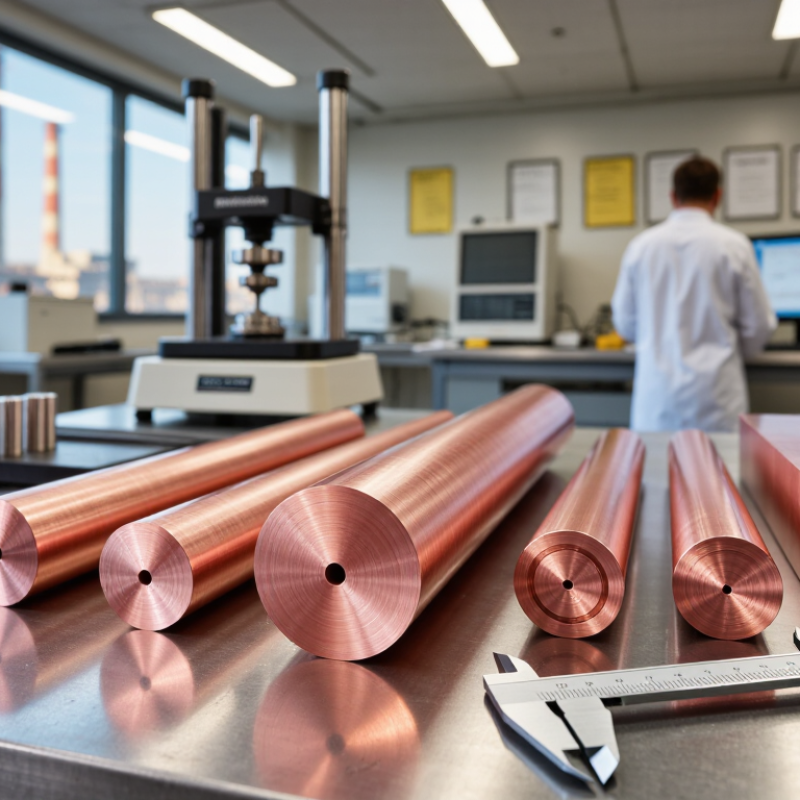
Oxygen-free high-conductivity tellurium copper combines strong electrical performance with improved machinability. Tellurium helps the copper form clean chips during drilling, turning, and milling. This matters when producing terminals, connectors, switch parts, and precision components. Its conductivity remains high, but it is usually lower than pure oxygen-free copper. That trade-off is easy to underestimate.
When buying this material, request the exact chemical composition and conductivity value, often expressed as a percentage of IACS. Confirm the temper, hardness, tensile strength, dimensions, and surface condition. Ask for a material certificate with heat numbers and test results. “Oxygen-free” should describe controlled production, not an assumption of absolutely zero oxygen. Small differences in composition can affect machining and conductivity.
Check how the copper will perform in your actual design. A machinist may value its cutting behavior, while an electrical engineer may focus on resistance and heat generation. Examine sample bars or plates for scratches, edge damage, discoloration, and inconsistent dimensions. Do not rely only on a catalog description. A cheaper option may create more waste through poor tolerances or unstable properties. My own assessment would remain cautious until the certificate, sample inspection, and application requirements agree.
How to Buy Oxygen Free High Conductivity Tellurium Copper
Identifying the correct grade begins with the chemistry, not the product title. Tellurium copper is commonly supplied as UNS C14500, with copper as the base metal and approximately 0.4–0.7% tellurium. It combines high electrical conductivity with improved machinability. Do not assume “oxygen free” describes every C14500 product. Ask for the certified oxygen level and the applicable material standard.
Check the certificate for chemical limits, conductivity, hardness, tensile strength, and dimensional tolerances. A typical conductivity requirement may be around 90% IACS, but the exact value depends on the specification and product form. Rod, bar, plate, and wire can require different testing conditions. The temper also matters. A hard temper may machine differently from an annealed grade.
Look closely at the intended application. Switchgear contacts, precision terminals, and machined electrical parts may need different balances of conductivity and strength. Confirm whether the supplier uses ASTM, EN, or another recognized standard. Request heat numbers, test reports, and sample verification before placing a large order. I have seen buyers focus on conductivity alone, then discover that the supplied temper was unsuitable for tight machining. That mistake is easy to prevent, although specifications can still be interpreted differently. Ask the supplier to state every value in writing, including oxygen content, tellurium range, conductivity, and tolerance.
Electrical conductivity comparison at 20°C, expressed as a percentage of the International Annealed Copper Standard (IACS). C10100 and C10200 are oxygen-free copper grades commonly selected for high-conductivity applications. C14500 provides good conductivity with improved machinability, but it is tellurium copper rather than an oxygen-free grade unless the supplier provides separate oxygen certification.
| UNS Grade | Material Description | Reference Conductivity | Typical Selection Consideration |
|---|---|---|---|
| C10100 | Oxygen-free electronic copper | 101% IACS minimum | Very high conductivity and low oxygen content |
| C10200 | Oxygen-free copper | 100% IACS minimum | High conductivity for electrical and thermal components |
| C14500 | Tellurium copper | 90% IACS minimum | Improved machinability with good electrical conductivity |
Reference values can vary with product form, temper, test method, and applicable material standard. Confirm the required UNS designation, conductivity, oxygen limit, temper, dimensions, and heat or lot certification before purchasing.
Buying oxygen-free high-conductivity tellurium copper requires more than comparing prices. Confirm the exact grade, commonly C14500, and request a mill test certificate for every lot. The Copper Development Association lists tellurium copper near 90% IACS conductivity, while its machinability is much higher than pure copper. Ask suppliers to state conductivity, hardness, tensile strength, oxygen content, and tellurium percentage separately. Vague terms like “premium copper” are not technical evidence.
Certification should match the application. ASTM B301/B301M may support rod and bar requirements, but the standard must fit the supplied form and size. ISO 9001 confirms a quality-management system; it does not prove chemical composition. Request third-party test results, dimensional inspection records, and traceable heat numbers.
The U.S. Geological Survey’s Mineral Commodity Summaries 2025 shows copper remains a major global industrial material, but high production volume does not guarantee consistent specialty-alloy quality. A smaller supplier may provide better documentation. That assumption still needs testing.
Tips: Compare three recent certificates, not one sample. Use handheld XRF only for screening, because it may not measure oxygen accurately. Require conductivity testing with a recognized method, such as ASTM E1004. Inspect bars for dark oxidation, scratches, and uneven machining marks. I have found that packaging is often overlooked. Moisture-resistant wrapping and clear labels can prevent confusion during storage. One weakness remains: supplier claims can sound precise while omitting test conditions. Ask for the temperature, equipment, and laboratory accreditation behind every reported value.
Buying oxygen-free high conductivity tellurium copper requires more than comparing the listed price per kilogram. Ask whether the quote includes cutting, inspection, packaging, and export preparation. A lower price may reflect a larger tolerance or fewer quality documents. Request the copper grade, dimensions, conductivity range, hardness, and oxygen content in writing. Mill test certificates and independent inspection options improve purchasing confidence.
Minimum order quantities can change the real cost quickly. One supplier may accept 100 kilograms, while another requires a full production batch. A smaller order reduces storage pressure but often carries higher processing costs. Ask whether mixed sizes count toward the same minimum. Confirm acceptable substitutions before placing an order. Buyers sometimes focus too heavily on unit price. I have seen that mistake create expensive leftover stock.
Delivery terms deserve equal attention. Compare production lead time, dispatch location, transport method, insurance, and customs responsibility. Clarify whether the quoted term is EXW, FOB, CIF, or DDP, and check the exact delivery point. A shipment promised in ten days may still need three weeks for production. Ask for a realistic shipping window, not only an ideal date. Include packaging details, moisture protection, and pallet limits for long copper bars. Payment milestones also affect cash flow. The cheapest offer is not always the safest purchase.
Buying oxygen-free high-conductivity tellurium copper requires more than checking a bright surface. Start with the exact alloy designation, such as UNS C14500, and request the chemical composition. The certificate should show copper, tellurium, oxygen, impurities, heat number, and test methods. The U.S. Geological Survey’s Mineral Commodity Summaries 2025 estimates global tellurium production at roughly 800 metric tons in 2024. It also identifies tellurium mainly as a byproduct of copper refining. This limited supply makes traceability especially important.
Inspect each coil, bar, or plate under strong, even lighting. Look for scratches, oxidation stains, edge cracks, dents, and inconsistent color. Check dimensions at several points, not only at the package opening. Ask for conductivity in percent IACS, hardness, tensile data, and delivery condition. A product advertised as high conductivity should include test results, not vague wording. The Copper Development Association describes tellurium copper as a free-machining copper alloy, but machinability does not replace conductivity verification.
Review the mill test certificate against the physical heat number. Photograph labels before storage. A polished certificate is not proof of uniform material. This is where buyers sometimes become careless. Independent laboratory testing may be sensible for critical electrical contacts or thermal components. Verify sampling procedures, because one tested piece may not represent the entire lot. Also confirm packaging protects clean surfaces from moisture, dust, and mixed-metal contact during transport. Industry reports provide useful supply context, but purchase decisions still depend on lot-level evidence.
| Inspection or Purchasing Dimension | Recommended Requirement | Typical Technical Reference | How to Inspect or Verify | Why It Matters | Purchase Status |
|---|---|---|---|---|---|
| Material designation | Specify the exact copper alloy grade rather than using only the phrase “oxygen-free copper.” | Tellurium copper is commonly specified as UNS C14500 or an equivalent national designation. | Compare the purchase order, mill certificate, marking, and packing list. Confirm that the designation is consistent across all documents. | Oxygen-free copper and tellurium copper are different material categories; an incorrect designation can affect machinability and conductivity. | Required |
| Chemical composition | Require a heat or lot-specific chemical analysis. | For C14500, tellurium is commonly controlled at approximately 0.40–0.70% by mass, with copper making up the balance. Exact limits depend on the governing specification. | Review a certificate of analysis and, for incoming inspection, use an appropriate laboratory method such as optical emission spectroscopy or X-ray fluorescence screening. | Tellurium content influences free-machining behavior, electrical performance, and compliance with the ordered grade. | Verify |
| Electrical conductivity | State the minimum conductivity required for the application and identify the test basis. | Commercial C14500 products are often specified around 85% IACS minimum, but the required value may vary by product form, temper, and standard. | Check the material certificate for conductivity in % IACS or MS/m. Confirm the test temperature and method; do not rely only on nominal grade information. | Conductivity affects current-carrying capability, electrical losses, and suitability for connectors, terminals, and current-carrying components. | Required |
| Oxygen requirement | Clarify whether the application requires oxygen-free copper, low-oxygen copper, or tellurium copper with a specified oxygen limit. | “Oxygen-free high-conductivity” is not automatically interchangeable with tellurium copper. Oxygen limits must be stated separately in the purchase specification. | Request the applicable oxygen limit and the analytical method from the supplier. Confirm that the certificate reports oxygen when it is a critical requirement. | Oxygen level can influence joining, high-temperature service, hydrogen sensitivity, and the suitability of copper for specialized applications. | Verify |
| Product form | Identify the required form and delivery condition. | Common forms include round bar, plate, sheet, strip, tube, wire, and machined semi-finished parts. | Confirm the form, cross-section, length, coil or straight condition, surface condition, and packaging method on the quotation. | Different product forms may have different dimensional tolerances, mechanical properties, and available standards. | Required |
| Dimensions and tolerance | Specify nominal dimensions, allowable tolerance, straightness, flatness, and cut length where applicable. | Use the tolerance class stated by the applicable ASTM, EN, JIS, or other agreed product standard. | Measure representative pieces with calibrated micrometers, calipers, gauges, or a coordinate measuring system. Record actual readings by heat or lot. | Correct dimensions reduce machining allowance, assembly problems, scrap, and disputes over acceptance. | Required |
| Temper and mechanical condition | Specify annealed, half-hard, hard, or another defined temper when mechanical properties are important. | Hardness, tensile strength, yield strength, and elongation vary with alloy form and temper; no single value applies to every product. | Check the certificate against the ordered temper. If necessary, perform hardness or tensile testing using the relevant product standard. | Temper affects forming, machining, spring-back, wear resistance, and dimensional stability. | Verify |
| Surface condition | Require a clean surface free from harmful cracks, laps, deep scratches, excessive scale, oil contamination, or corrosion. | Minor handling marks may be acceptable only when they do not exceed the agreed visual or dimensional limits. | Inspect under adequate lighting. Use magnification or dye penetrant testing only when required by the application and specification. | Surface defects can initiate cracks, interfere with plating or soldering, and reduce contact reliability. | Required |
| Internal quality | Define whether ultrasonic, eddy-current, radiographic, or other nondestructive testing is required. | Testing should be based on product form, thickness, safety class, and the agreed acceptance criteria. | Request a test report identifying the method, coverage, sensitivity, calibration reference, and acceptance level. | Internal discontinuities may not be visible during routine visual inspection but can affect machining and service performance. | Application-dependent |
| Heat and lot traceability | Each shipment should be traceable to a heat, cast, batch, or production lot. | Traceability should link product markings to the inspection certificate and packing documentation. | Check stamped or tagged identification, lot numbers, labels, and certificate references before removing packaging. | Traceability supports incoming inspection, root-cause analysis, warranty control, and controlled production release. | Required |
| Certificate documentation | Request a certificate of conformity and, when needed, a material test report. | Documentation should include grade, standard, dimensions, quantity, heat or lot number, chemical results, mechanical results, conductivity, and test dates where applicable. | Check that the certificate describes the actual shipment and is signed or digitally authorized by the responsible quality function. | Complete documentation demonstrates that the supplied material matches the purchase requirements. | Required |
| Sampling plan | Agree on sampling frequency and acceptance criteria before delivery. | Sampling may be based on lot size, product form, risk level, or the quality plan specified in the contract. | Sample from multiple bundles or locations when practical. Retain inspection records and photographs for nonconforming material. | A defined plan prevents inconsistent decisions and reduces the risk of accepting an unrepresentative sample. | Agree in advance |
| Packaging and transport | Require dry, secure, and damage-resistant packaging suitable for the product form and route. | Use separators, end protection, moisture-resistant wrapping, and secure strapping when appropriate. | Inspect packaging for punctures, water ingress, crushed ends, movement, and mixed-lot labeling immediately upon receipt. | Good packaging helps prevent oxidation, dents, deformation, contamination, and loss of traceability. | Required |
| Storage before use | Store indoors in a clean, dry, low-contamination area with stable temperature and humidity. | Keep copper products off the floor and separate from chemicals, salt spray, carbon steel scale, and other sources of contamination. | Use first-in, first-out control where practical. Inspect for condensation, staining, corrosion, and damaged identification before production. | Correct storage preserves surface quality and prevents corrosion or material mix-ups. | Required |
| Safe handling | Use suitable lifting equipment and personal protective equipment for heavy, sharp-edged, or bundled products. | Follow the site lifting plan and applicable occupational safety requirements. | Check bundle weight, lifting points, stability, sharp edges, and safe access before moving the material. | Proper handling reduces the risk of crush injuries, cuts, dropped loads, and product damage. | Required |
| Final purchase approval | Approve the order only after grade, composition, conductivity, dimensions, temper, testing, documents, packaging, and delivery terms are confirmed. | Use a written technical specification attached to the purchase order. | Compare the quotation and pre-shipment documents with the approved specification. Record any deviation in writing before acceptance. | A complete approval process reduces the likelihood of receiving unsuitable or non-traceable material. | Required |
Check that copper is the base metal, with about 0.4–0.7% tellurium. Ask for the certified oxygen level. Do not trust the title alone.
No. The grade name does not prove the oxygen content. Request the oxygen limit in writing. This is easy to overlook.
Check chemistry, conductivity, hardness, tensile strength, and dimensional tolerances. Also request the heat number and test report. Paperwork matters.
A common requirement is around 90% IACS, but exact values vary. Product shape and testing conditions can change the result. Confirm the required range.
Yes. Hard temper and annealed material can machine differently. A hard bar may resist deformation but complicate tight machining. I would not ignore temper.
Switchgear contacts, precision terminals, and machined parts need different strength balances. Confirm whether conductivity, strength, or machinability matters most. One value is not enough.
Compare grade, dimensions, conductivity, hardness, oxygen content, inspection, packaging, and cutting costs. A cheaper quote may include wider tolerances or fewer documents. The lowest price can mislead.
Ask whether mixed sizes count toward one minimum order. A smaller order reduces storage, but processing costs may rise. Unused stock is expensive.
Confirm production time, dispatch location, transport, insurance, customs responsibility, and delivery point. Clarify the agreed trade term. Ten days may mean three weeks overall.
Ask about moisture protection, pallet limits, wrapping, and handling during transport. Long bars can suffer damage without stable support. I might underestimate this cost.
Buying Oxygen Free High Conductivity Tellurium Copper requires careful attention to material performance, grade selection, and application requirements. First, confirm the copper’s tellurium content, oxygen level, conductivity, mechanical strength, dimensional tolerances, and form, such as rod, bar, plate, or wire. The correct specification should match the intended use, especially where excellent electrical conductivity, machinability, and resistance to softening are important. Clear technical documentation and consistent quality are essential for reliable processing and long-term performance.
When comparing suppliers, review certificates of analysis, inspection reports, production capabilities, and quality-control procedures. Evaluate pricing together with minimum order quantities, packaging, lead times, shipping conditions, and after-sales support rather than choosing solely on the lowest quote. Before purchase, inspect sample dimensions, surface condition, markings, and documentation. Handle and store the material safely, keeping it dry, protected from contamination, and clearly identified throughout transportation and production.

Kepai New Material