Choosing among the 5 Best C18150 CrZrCu Materials for Global Buyers requires more than comparing prices. C18150 Crzrcu Material combines copper’s electrical conductivity with chromium and zirconium additions that improve hardness, strength, and resistance to softening. This balance supports demanding applications, including resistance welding electrodes, electrical contacts, heat-transfer parts, and high-temperature tooling.
The best option depends on the buyer’s actual operating conditions. A welding manufacturer may prioritize conductivity, surface wear, and stable performance after repeated heating. A machined-parts producer may need predictable hardness, tight dimensions, and reliable cutting behavior. Product form also matters. Bars, plates, tubes, and custom components can show different processing histories and performance results.
Small details matter.
This guide compares five material options using practical criteria: chemical consistency, mechanical properties, thermal stability, machinability, documentation, and supplier reliability. Inspection reports, heat numbers, dimensional records, and traceability should support every serious quotation. Certificates alone are not enough. Buyers should confirm the testing method, delivery condition, and applicable international specifications before placing an order.
There is no universal winner. A material with excellent conductivity may not offer the highest wear resistance. Another option may perform well in production but cost more because of tighter controls. Published values can also vary with temper, heat treatment, and sample direction. That point is easy to overlook.
The following comparison is designed to help global purchasers ask sharper questions, reduce material-selection risk, and match each C18150 CrZrCu grade with its real service environment. Supplier capability still requires direct verification.
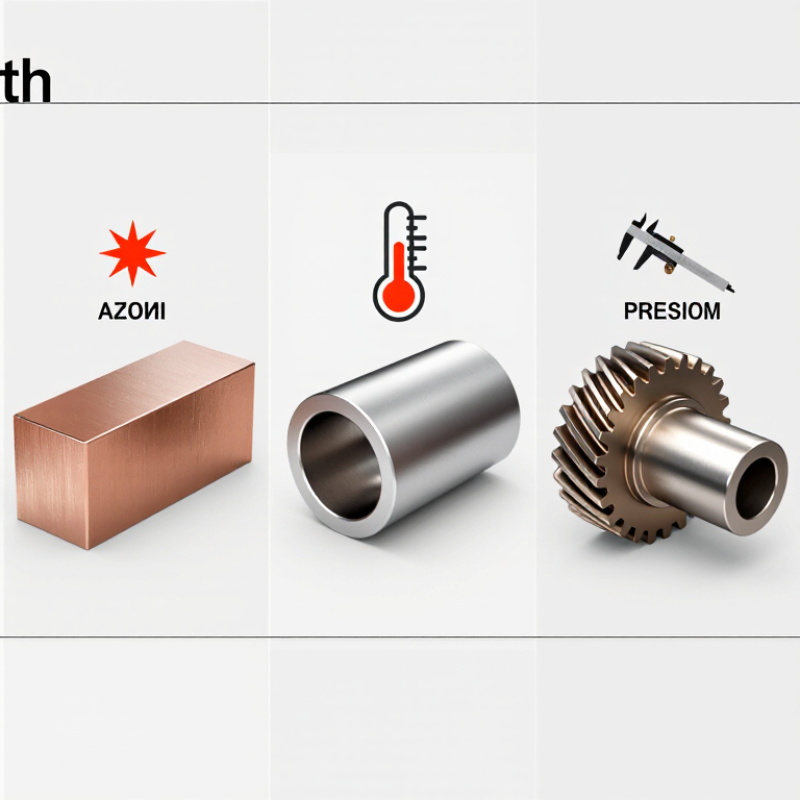
What Is C18150 CrZrCu and Why Is It Used Worldwide?
C18150 CrZrCu is a precipitation-hardenable copper alloy. Its chemistry usually includes 0.5–1.2% chromium and 0.03–0.30% zirconium, with copper as the balance. The exact range depends on the applicable specification. Heat treatment forms fine precipitates, increasing hardness without sacrificing too much electrical conductivity. Typical conductivity reaches approximately 75–85% IACS. That balance explains its worldwide use in resistance-welding electrodes, electrical contacts, connector parts, and heat-transfer components. It performs well under repeated current and pressure.
Demand pressure is real. The USGS Mineral Commodity Summaries 2024 recorded about 22 million tonnes of mined copper production worldwide in 2023. The International Energy Agency’s Global Critical Minerals Outlook 2024 places global copper demand near 26 million tonnes in 2023 and projects roughly 31 million tonnes by 2035 under its stated policy scenario. C18150 helps engineers use copper more efficiently where pure copper softens too quickly. In practical purchasing, buyers should verify hardness, conductivity, grain condition, and heat-treatment records rather than trust the alloy name alone. Small differences matter. A poorly controlled aging cycle can reduce performance, even when the chemistry appears correct. It is not a perfect universal alloy. For high-current welding, engineers often compare electrode wear, contact resistance, cooling design, and operating temperature through documented trials. ASTM and ISO test methods improve comparability, but supplier certificates still require careful review.
Key Properties Buyers Should Compare in C18150 Materials
When comparing C18150 CrZrCu materials, buyers should examine conductivity, strength, hardness, and softening resistance together. A high conductivity value alone can hide poor service performance. ASTM-linked technical datasheets commonly report electrical conductivity around 75–85% IACS, depending on heat treatment and product form. The International Annealed Copper Standard uses 100% IACS as the reference for pure annealed copper.
Strength also changes sharply with temper. Age-hardened C18150 typically reaches tensile strengths near 500–700 MPa, while softer conditions provide easier forming. Reported hardness often falls between approximately 75 and 100 HRB. These figures are useful, but not universal. Buyers should request the exact test condition, gauge size, and sampling location. Small details matter.
Thermal performance is critical for resistance welding electrodes, current-carrying contacts, and hot tooling. Industry datasheets frequently list thermal conductivity near 300–330 W/m·K, with softening temperatures commonly reported above 500°C. Compare these values with the expected duty cycle, not only room-temperature specifications. Ask for chemical analysis confirming chromium and zirconium limits under the applicable copper alloy standard. Also review density, ultrasonic quality, dimensional tolerance, and delivered hardness. Some published numbers look impressive. They may describe laboratory material, not production stock. A practical supplier should provide batch certificates, retest procedures, and traceability. One overlooked issue is machinability after aging; it can be less forgiving than expected.
5 Best C18150 CrZrCu Materials for Global Buyers? - Key Properties Buyers Should Compare in C18150 Materials
| Material Option |
Typical Product Form |
Typical Temper |
Cr Content
wt.% |
Zr Content
wt.% |
Electrical Conductivity
% IACS |
Thermal Conductivity
W/m·K |
Tensile Strength
MPa |
Hardness
HV |
Recommended Use |
| C18150 Aged Bar and Rod |
Round bar, square bar, hexagonal bar and machined rod |
Solution treated and precipitation aged |
0.50–1.20 |
0.03–0.30 |
75–85 |
300–340 |
550–700 |
150–210 |
Resistance-welding holders, shanks, electrodes and high-load conductive components |
| C18150 Plate and Sheet |
Flat plate, sheet and cut-to-size blanks |
Cold worked and aged, or solution treated and aged |
0.50–1.20 |
0.03–0.30 |
75–85 |
300–340 |
520–680 |
145–205 |
Heat-resistant contact plates, backing plates, dies and structural electrical parts |
| C18150 Strip and Foil |
Precision strip, narrow strip and thin-gauge foil |
Cold rolled and age hardened |
0.50–1.20 |
0.03–0.30 |
78–88 |
310–350 |
600–800 |
170–230 |
Spring contacts, electrical connectors, relay parts and compact heat-transfer components |
| C18150 Wire |
Round wire, welding wire and formed wire |
Cold drawn and aged |
0.50–1.20 |
0.03–0.30 |
75–85 |
300–340 |
600–850 |
170–240 |
Resistance-welding electrodes, contact tips, springs and fine conductive assemblies |
| C18150 Tube and Hollow Section |
Seamless tube, drawn tube and custom hollow section |
Drawn, stress relieved and optionally aged |
0.50–1.20 |
0.03–0.30 |
75–85 |
300–340 |
500–650 |
140–200 |
Water-cooled welding components, conductive cooling channels and high-temperature tooling |
Buyer’s verification note: C18150 is a precipitation-hardening copper-chromium-zirconium alloy, and final properties depend on product size, cold work, heat treatment and testing method. The values above are representative purchasing ranges rather than guaranteed specifications. Confirm the required chemistry, temper, dimensions, conductivity, mechanical properties, surface condition and inspection requirements on the supplier’s mill certificate.
Five Leading C18150 CrZrCu Material Options for Different Applications
C18150 CrZrCu materials serve demanding electrical, thermal, and mechanical applications.
Their chromium and zirconium content improves strength, softening resistance, and conductivity. The best choice depends on geometry, heat exposure, and contact pressure.
C18150 plate suits resistance welding electrodes, backing plates, and heat spreaders. It offers stable performance under repeated thermal cycles.
Rod and bar formats fit electrode holders, shafts, and conductive fixtures. They machine well, but tool wear may increase with harder tempers.
Strip material supports springs, relay contacts, and precision connectors. Its thin profile helps control deflection and electrical resistance.
Tube and hollow-section options reduce weight in cooling components and electrode assemblies. They need careful inspection for wall thickness variation.
Forged or custom-shaped C18150 parts work well for heavy-duty dies and complex copper assemblies. Forging can improve structural reliability, though costs and lead times may rise.
In practical purchasing, compare conductivity, hardness, temper, and dimensional tolerance together. A high hardness value does not guarantee better service life.
Check certificates, chemical composition, ultrasonic quality, and surface condition before production. Ask suppliers for test data from the actual heat or batch.
This detail matters. Joining methods also deserve attention, especially when brazing or welding near hardened areas.
I have found that cooling design is often underestimated. Even excellent material may fail when heat cannot escape.
Trial samples remain valuable, because drawings rarely reveal every operating stress.
How to Evaluate Suppliers, Standards, and Product Certifications
For global buyers, the five best C18150 CrZrCu materials are not selected by price alone. They should be compared through chemistry, conductivity, hardness, dimensions, and traceability. C18150 usually contains chromium and zirconium within controlled ranges, but limits may vary by specification. Ask suppliers to state the applicable UNS, ASTM, EN, or customer standard clearly.
A reliable supplier provides a mill test certificate for every heat or batch. The certificate should show chemical composition, tensile or hardness results, electrical conductivity, and delivery condition. Match its heat number with the material marking and packing list. An ISO 9001 certificate supports process control, while an ISO/IEC 17025 laboratory report gives stronger confidence in test results. Still, a certificate alone is not proof. Request recent sample data and independent testing when the application is critical.
Check whether the supplier can maintain stable properties after extrusion, rolling, forging, or heat treatment. Ask about tolerances, surface defects, straightness, and protective packaging. For international shipments, verify declarations related to restricted substances and the destination market’s requirements. I would not trust a polished PDF without traceable records. One practical weakness is often overlooked: buyers compare nominal conductivity, but ignore test temperature and measurement method. That mistake can create costly disputes later. A small trial order, inspected before mass production, reveals more than confident sales language.
Which C18150 CrZrCu Material Best Fits Your Global Purchasing Needs?
Choosing the right C18150 CrZrCu material depends on application details, not only the alloy name. This copper-chromium-zirconium grade offers strong electrical conductivity, hardness, and resistance to softening under heat. For resistance welding electrodes, C18150 rod or bar usually fits best. Plate suits electrode holders and wear parts. Tube works well for cooling channels and custom assemblies. Strip supports precise electrical contacts. Forged or machined shapes may reduce waste in demanding production.
Tips:
Ask for the exact temper, dimensions, conductivity value, hardness range, and heat-treatment condition. Request a material test report before shipment. Global buyers should also confirm packaging, inspection methods, tolerance standards, and export documents. Small differences in temper can affect machining and service life. That detail is often underestimated.
A practical purchasing decision should compare five points: electrical performance, thermal stability, mechanical strength, machinability, and total delivered cost. I would not select the hardest option automatically. Excessive hardness may increase machining difficulty or reduce forming flexibility. One common mistake is comparing price before checking the finished geometry. A lower-cost bar can create more machining waste than a near-net forged part. Confirm sample performance under real current, pressure, and temperature conditions. Laboratory data helps, but field conditions can be less forgiving.
Conclusion
C18150 Crzrcu Material, commonly recognized as a chromium-zirconium copper alloy, is valued worldwide for its excellent electrical and thermal conductivity, high strength, wear resistance, and ability to maintain performance at elevated temperatures. These characteristics make it suitable for resistance welding electrodes, electrical contacts, connectors, molds, and other demanding industrial components. When comparing materials, global buyers should review hardness, tensile strength, conductivity, softening temperature, dimensional accuracy, surface condition, and the balance between strength and machinability.
The five leading material options can be selected according to application needs, including standard high-conductivity grades, higher-hardness variants, wear-resistant forms, heat-treated products, and customized shapes or sizes. Buyers should also evaluate supplier production capabilities, traceability, quality-control procedures, applicable international standards, inspection reports, and certifications. The best C18150 Crzrcu Material is ultimately determined by the operating environment, required service life, manufacturing process, delivery expectations, and total purchasing cost rather than by a single property alone.

 Kepai New Material